
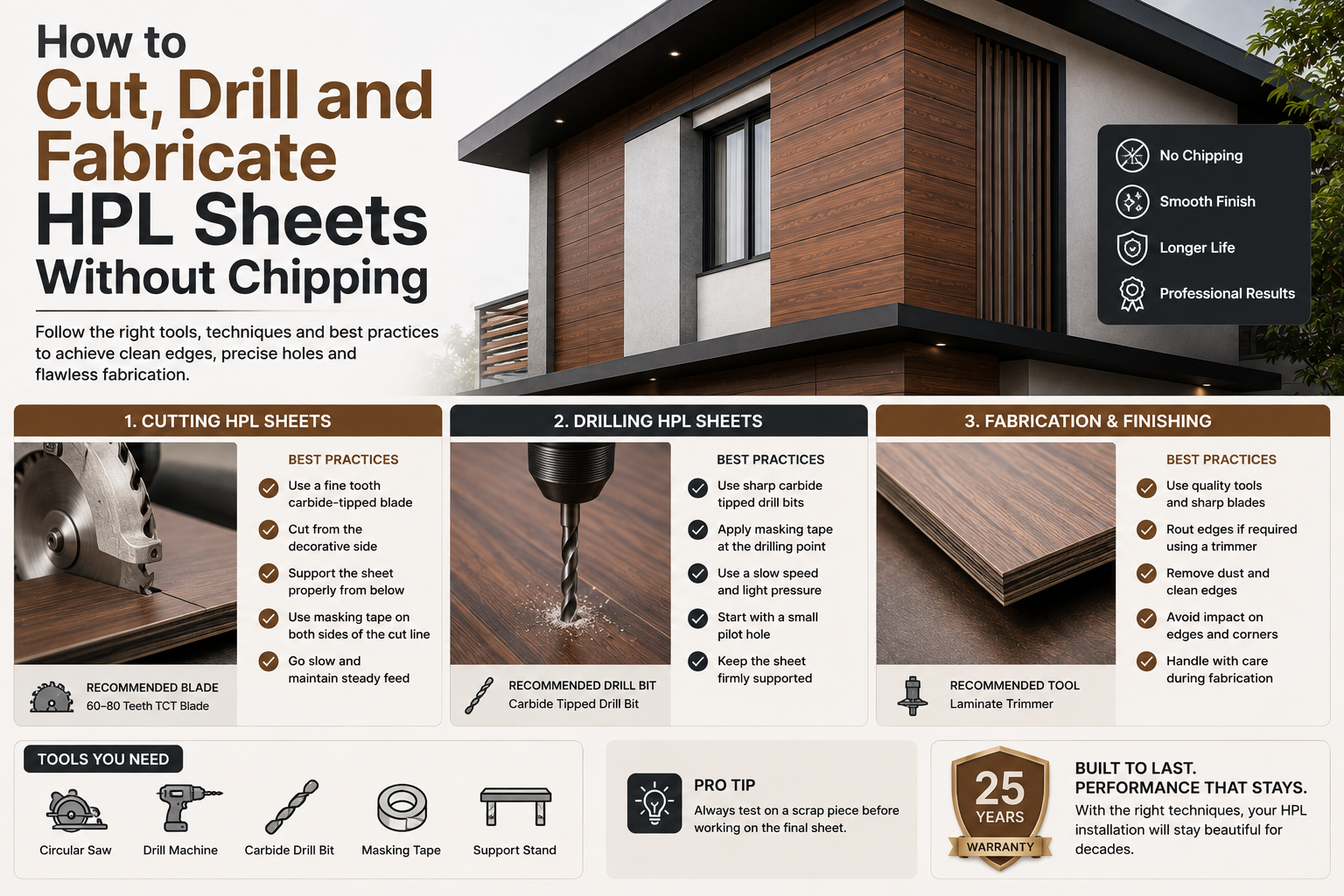
Quick answer: Cut HPL with carbide-tipped or diamond-tipped blades at high rotation speed and slow, steady feed, supporting the panel fully. Drill fixing holes oversized so the panel can move, and always drill a radius at internal corners of any cut-out. Sharp corners and blunt blades are the two main causes of chipping and cracking.
Table of Contents
- Why HPL Behaves Differently from Plywood
- Tools and Blades That Work
- Drilling Fixing Holes Correctly
- Cut-Outs, Corners and Crack Prevention
- Safety and Site Practice
- When to Order Cut-to-Size Instead
- Frequently Asked Questions
Why HPL Behaves Differently from Plywood
HPL is resin-saturated kraft paper compressed into a dense, hard, slightly brittle sheet. It is far more abrasive than timber, so standard high-speed steel tooling dulls within a few metres of cut, and a dull blade tears the decorative surface instead of slicing it.
It is also stiff rather than springy. Where plywood tolerates being cut half-supported over a trestle, HPL will chip along the underside as it flexes. Full support and correct tooling solve nearly every fabrication problem people report.
Tools and Blades That Work
| Operation | Recommended tool | Key setting |
|---|---|---|
| Straight cuts | Panel saw or circular saw with carbide-tipped blade, 60-96 teeth | High rpm, slow steady feed |
| Fine finish cuts | Diamond-tipped blade | Best edge quality, longest life |
| Curves and cut-outs | CNC router with carbide compression bit | Multiple shallow passes |
| Holes | Carbide-tipped drill bit | Low speed, backing board underneath |
| Large circular openings | Hole saw with carbide teeth | Support both sides, drill slowly |
| Edge finishing | Router with chamfer bit or hand file | Light passes, remove burr only |
Whichever tool you use, cut with the decorative face oriented so the blade teeth enter the face rather than exit through it – for a hand circular saw that means face down, for a table or panel saw it means face up.
Drilling Fixing Holes Correctly
This is the detail that separates a facade that lasts from one that cracks in its second summer. The panel must be free to expand.
- Use a carbide bit and a firm backing board to prevent breakout on the exit side.
- Make the hole oversized relative to the fastener – a common approach is a hole around 8-10mm for a 5mm rivet, following the fixing system’s specification.
- Leave one fixed point per panel, usually near the centre, with all other holes oversized.
- Keep holes at least the recommended distance from the panel edge, typically around 20-30mm, so the material around the hole has strength.
- Deburr both faces after drilling.
Cut-Outs, Corners and Crack Prevention
Any internal corner is a stress concentration. In a dense laminate under daily thermal cycling, a sharp 90-degree notch is a crack waiting to start.
- Drill a hole at each internal corner first, then cut between the holes – this gives you an automatic radius.
- Use the largest radius the design allows; a minimum of around 5mm is a common workshop rule.
- Avoid placing cut-outs close to panel edges or fixing points where possible.
- For a slot or a service penetration, round both ends rather than leaving square terminations.
Safety and Site Practice
Cutting HPL creates fine dust made of cured resin and paper fibre. It is not exotic, but it is fine, and it should not be inhaled or left to settle on wet paint and glazing.
- Wear a dust mask, eye protection and gloves; cut outdoors or with extraction.
- Keep a vacuum at the cut line rather than sweeping dust into the air later.
- Never dry-cut into a finished interior space; dust travels far and settles on everything.
- Stack cut panels flat and interleaved, never face to face without protection.
When to Order Cut-to-Size Instead
Site cutting is normal and often unavoidable, but factory cutting is worth paying for in three situations: repetitive components such as louvre blades and fascia bands, panels where the cut edge will be highly visible, and projects with tight programme where site labour is the bottleneck.
HPL Maker can supply panels cut to an approved panel schedule, which removes a large share of site wastage and gives consistent edges across the whole elevation.
Key Takeaways
- Use carbide or diamond tooling at high rpm with a slow, steady feed.
- Support the panel fully and orient the face so teeth enter rather than exit it.
- Oversize fixing holes and keep one fixed point per panel.
- Radius every internal corner – drill first, then cut between holes.
- Wear dust protection and stack cut panels flat and interleaved.
Frequently Asked Questions
What blade should I use to cut HPL sheets?
A carbide-tipped blade with 60-96 teeth works well for straight cuts, and a diamond-tipped blade gives the best edge quality and longest life. High-speed steel blades dull very quickly because HPL is abrasive.
Can HPL be cut with a jigsaw?
It can for small cut-outs, using a fine-tooth carbide blade and a slow feed, but jigsaw cuts tend to chip and wander. A circular saw with a guide rail or a CNC router gives far better results on visible edges.
Why does my HPL chip while cutting?
Usually a blunt blade, too fast a feed, insufficient support under the cut line, or the wrong face orientation for the tool. Fixing those four things resolves almost all chipping.
How big should the fixing hole in an HPL panel be?
It should be oversized relative to the fastener so the panel can expand – commonly around 8-10mm for a 5mm rivet – with one fixed point per panel. Always follow the fixing system manufacturer’s specification.
Do I need to seal cut edges of exterior HPL?
Exterior-grade HPL is a solid, low-absorption laminate and does not need edge sealing for water resistance. Deburring and cleaning the edge is still good practice for appearance and joint consistency.
Related Reading on HPL Maker
Talk to HPL Maker
HPL Maker is an Indian manufacturer of exterior-grade high pressure laminate with an industry-first live camera warranty of up to 25 years. Share your drawings or elevation photos and our team will suggest the right shade, thickness and fixing system for your project.
- Call / WhatsApp: +91 89824 90236
- Email: marketing@hplmaker.com
- Factory & Head Office: 124-126, Vrindavan Palace, Nipania Main Road, Vijay Nagar, Indore – 452010, Madhya Pradesh, India